
Services
Our experienced remediation teams deliver technically sound concrete rehabilitation solutions that restore structural integrity, extend asset life and protect critical infrastructure. With extensive experience across the mining, industrial, marine and civil sectors, we safely execute complex projects while maintaining the highest standards of quality, safety and project delivery.
Concrete deterioration is often driven by reinforcement corrosion, aggressive environmental exposure and decades of service. Corrosion Coating Solutions delivers engineered remediation solutions that restore structural integrity, enhance durability and extend the operational life of critical infrastructure.
With extensive experience across mining, industrial, marine and civil sectors, our specialist teams safely execute complex remediation projects using industry-proven repair methodologies and corrosion management systems. Where cathodic protection is incorporated, we provide ongoing monitoring and performance verification to ensure long-term asset protection.
Each remediation methodology is selected according to the identified deterioration mechanism, structural requirements, substrate condition, exposure environment, operational constraints and required service life. Works are delivered under project-specific methodologies, inspection and test plans and quality documentation, with reference to applicable Australian Standards, the ACRA Guide to Concrete Repair and Protection and recognised international standards.
Controlled demolition removes unsound, delaminated, contaminated or structurally defective concrete while protecting the retained structure, reinforcement and adjacent services. Methods span electric, pneumatic and hydraulic breakers, robotic demolition, concrete saws and high or ultra-high-pressure hydrodemolition, selected to suit deterioration depth, reinforcement configuration, structural sensitivity and permissible vibration, noise, dust and water discharge.
Typical applications: bridges and bridge decks, wharves and marine structures, process plants, tanks and water-retaining structures, cooling towers, tunnels and culverts, foundations and mining infrastructure.
Crack injection restores structural continuity, seals cracks against water and contaminant ingress and consolidates fractured or voided concrete. Low-viscosity epoxy resins are used for dormant structural cracks requiring high bond strength; flexible polyurethane, hydrophilic polyurethane or acrylic resins are selected where cracks are wet, actively leaking or subject to movement. Injection pressures are controlled to suit the concrete condition, crack geometry and structural configuration.
Typical applications: bridges and structural beams, columns and walls, tanks, tunnels and culverts, marine infrastructure, foundations, industrial floors and precast elements.
Waterstop injection controls active or recurring water ingress through joints, cracks, penetrations and discontinuities by intercepting the leakage path and forming a flexible barrier within or behind the structure. Water-reactive materials are selected to suit water flow, joint movement, void condition and required flexibility, with injection sequencing planned to control active water and establish continuity along the treated joint.
Typical applications: basements and below-ground structures, tanks and reservoirs, tunnels and shafts, dams and spillways, marine structures, service penetrations and water-treatment infrastructure.
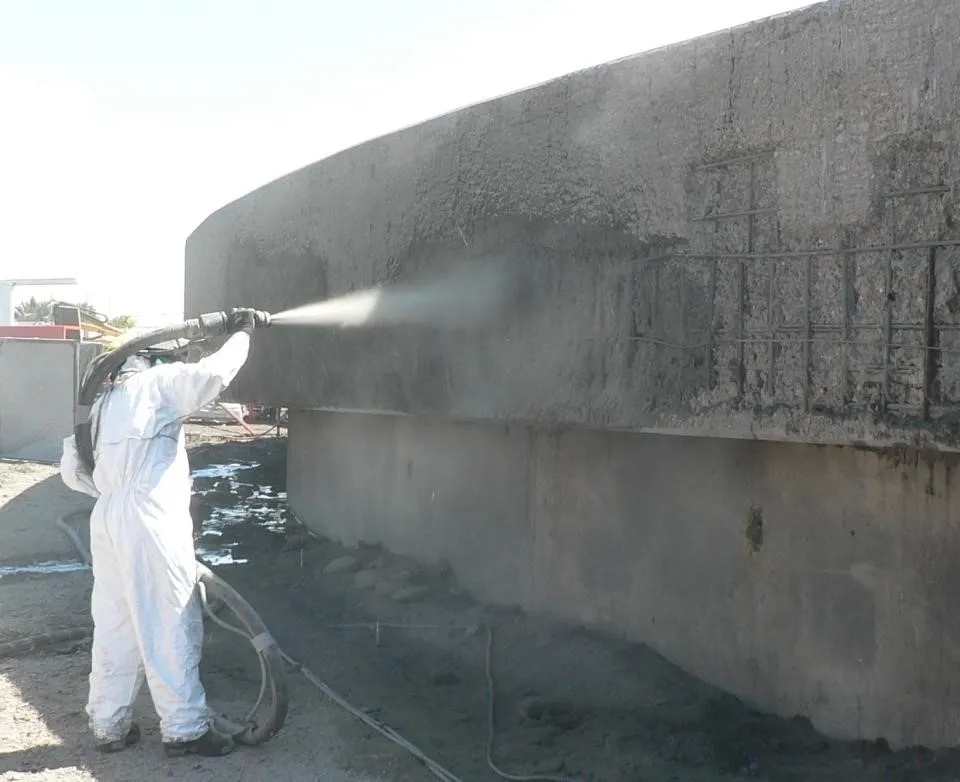
Dry-mix gunite pneumatically conveys pre-blended dry material to the nozzle, where water is introduced and controlled by the operator immediately before high-velocity placement. The method suits localised structural repairs, overhead and vertical reinstatement, thin-layer repairs and complex profiles without conventional formwork. Delivery includes preconstruction trials, substrate and reinforcement preparation, layered application, rebound control, finishing and curing.
Typical applications: tunnels, bridge beams and substructures, wharves and marine structures, tanks and reservoirs, retaining walls, cooling towers and mining infrastructure.
Wet-mix shotcrete is batched, pumped and pneumatically projected at high velocity, providing rapid placement, effective compaction and high production rates on vertical, overhead and irregular surfaces. It is delivered for structural reinstatement, section enlargement, strengthening, large-area rehabilitation and ground support, with mix designs incorporating supplementary cementitious materials, fibres, accelerators and durability admixtures. Robotic application improves safety and consistency in tunnels, confined spaces and extensive remediation zones.
Typical applications: tunnels and shafts, retaining walls and slopes, bridge substructures, wharves and marine assets, tanks and reservoirs, industrial process structures and mining infrastructure.
Pressure and contact grouting fill voids, restore contact, consolidate fractured materials and improve load transfer between concrete, steelwork, rock, masonry and structural interfaces. Cementitious, microfine, non-shrink, epoxy, polyurethane, acrylic and specialist chemical grout systems are selected to suit void geometry, required strength, water conditions and allowable pressure, with real-time pressure, flow and volume recording throughout.
Typical applications: tunnel linings, baseplates and structural bearings, machine foundations, bridge bearings, dams and spillways, wharves, ducts and inaccessible structural voids.
Form-and-pour repairs use flowable or pumpable cementitious microconcrete, repair concrete or specialist grout placed within engineered, sealed formwork, suited to deep sections, large-volume reinstatement and heavily reinforced elements where hand-applied or sprayed systems are impractical. Formwork is designed to withstand placement pressure and prevent grout loss, with placement sequencing controlled to minimise air entrapment, segregation and cold joints.
Typical applications: columns and beams, walls and soffits, bridge elements, marine structures, equipment foundations, plinths and pedestals, and bearing replacements.
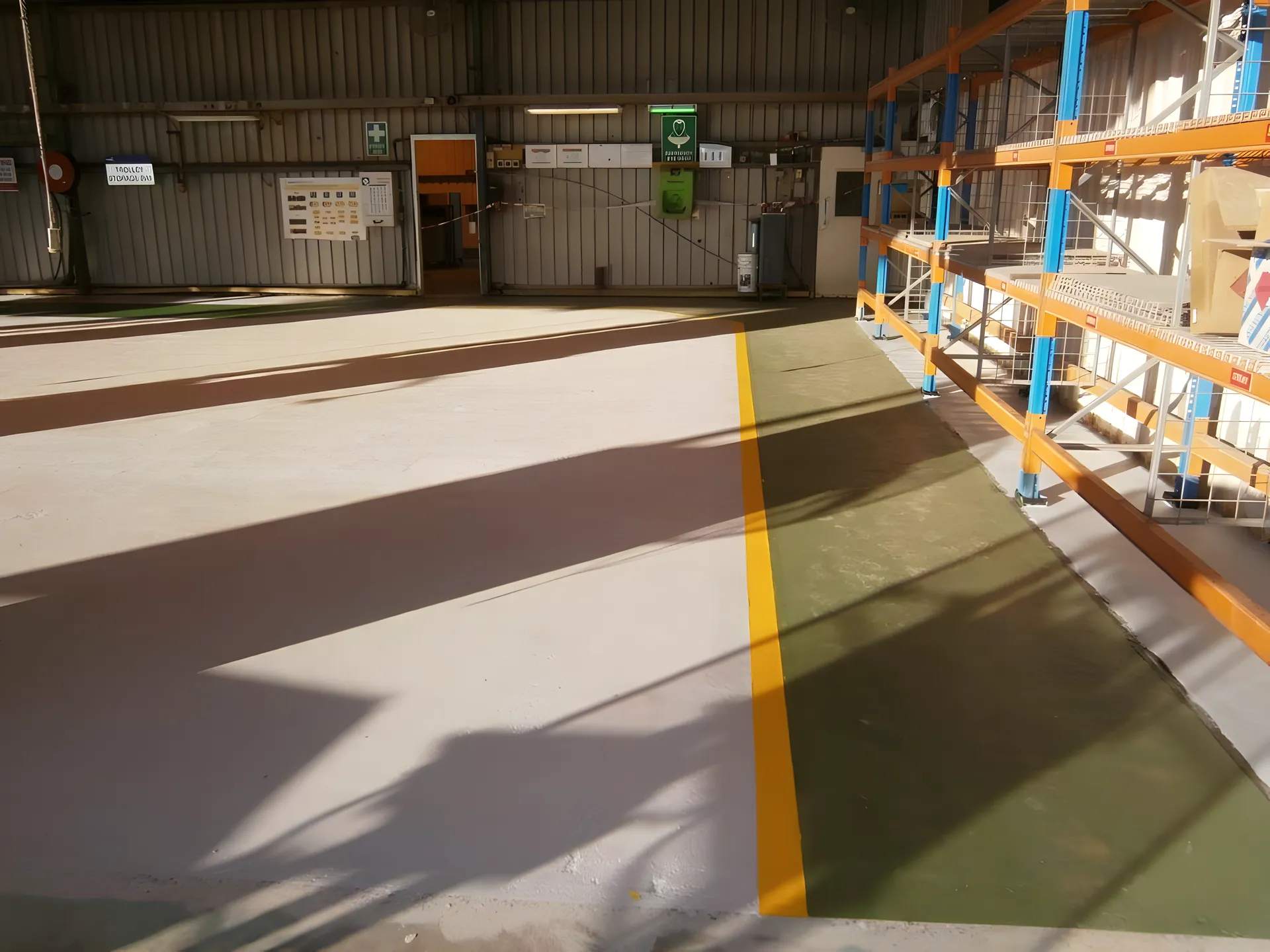
Floor coating systems protect slabs from abrasion, chemicals, moisture, oils and operational wear while providing cleanable, slip-resistant and visually defined working surfaces. Systems include high-build epoxies, polyurethane and polyurethane-cement systems, methyl methacrylate, flexible membranes, chemical-resistant linings, non-slip broadcast finishes and line marking, selected for substrate condition, moisture, chemical exposure, traffic loading and return-to-service time.
Typical applications: workshops and maintenance facilities, process plants, warehouses, food and beverage facilities, water infrastructure, chemical-handling and bunded areas, and industrial traffic zones.
Joint reinstatement restores a structure’s ability to accommodate designed movement while reducing the ingress of water, chemicals and debris. Works include removal of failed sealants and fillers, controlled saw-cutting and joint reforming, repair of joint arrises, backing rods, primers, elastomeric sealants, waterstops, trafficable joint systems and proprietary mechanical joints, with sealant geometry controlled to allow designed movement.
Typical applications: bridge decks, industrial floors, warehouses, tanks and reservoirs, wharves, water-treatment facilities, process plants and car parks.
Cathodic protection controls reinforcement corrosion by applying an electrochemical current that significantly reduces the corrosion rate, using impressed current, galvanic or hybrid systems. Installation covers reinforcement continuity verification, anodes, reference electrodes, corrosion-monitoring probes, cabling, transformer-rectifier units, testing, commissioning and performance verification, with remotely adjustable power supplies and web-connected monitoring available.
Typical applications: wharves and jetties, bridges, marine piles and headstocks, tanks and reservoirs, cooling towers, coastal infrastructure and chloride-contaminated buildings.
Sacrificial or galvanic anodes are installed within or adjacent to concrete repairs to provide localised corrosion control to reinforcing steel, preferentially corroding while supplying protective current. Systems include discrete patch-repair anodes, drilled-in anodes, distributed galvanic systems, ribbon or strip systems and encased anodes, with type, capacity and spacing determined from reinforcement density, concrete resistivity, chloride distribution and intended design life.
Typical applications: patch repairs, bridge structures, wharves and marine assets, columns and beams, car parks, coastal buildings and tanks.
System design begins with detailed condition assessment and corrosion investigation, from delamination surveys and chloride profiling to half-cell potential mapping and reinforcement continuity testing. The design defines protection zones, current-density requirements, anode type and distribution, monitoring locations and commissioning criteria. Structured monitoring programs with digital rectifiers, embedded sensors and remote telemetry give asset owners traceable performance data and early identification of changing corrosion conditions.
Typical applications: wharves, jetties and marine structures, bridges and transport infrastructure, tanks and reservoirs, cooling towers and chloride-contaminated reinforced concrete assets.
The performance and longevity of a remediation project are determined not only by workmanship but by the quality and suitability of the materials specified. Corrosion Coating Solutions supplies engineered repair materials and corrosion protection systems selected to restore structural integrity, maximise durability and withstand the operational and environmental demands of critical infrastructure.
Working with leading global manufacturers, we specify materials that are compatible with the existing substrate, meet recognised industry standards and support long-term asset performance. Every product is selected as part of an integrated remediation strategy to ensure safe installation, technical compliance and reliable, whole-of-life outcomes.
01
High-performance polymer-modified and cementitious repair mortars designed to restore concrete cover, reinstate structural capacity and provide long-term durability in aggressive service environments.
02
Precision cementitious and epoxy grouts for void filling, load transfer, equipment baseplates, bearing pads and structural reinstatement where high compressive strength and dimensional stability are required.
03
Epoxy and polyurethane injection resins for structural crack repair, water ingress control and void consolidation, restoring monolithic behaviour and preventing further deterioration.
04
Protective coatings, anti-carbonation coatings, hydrophobic impregnation systems and waterproof membranes designed to reduce chloride ingress, carbonation and environmental attack while extending asset durability.
05
Engineered corrosion mitigation technologies including cathodic protection, galvanic anodes, corrosion inhibitors and reinforcement treatments to control reinforcement corrosion and extend service life.
06
Zinc-rich primers, passivating coatings and reinforcement repair systems that protect exposed reinforcing steel during rehabilitation and reduce the risk of future corrosion.
07
Epoxy and polymer bonding agents that provide reliable adhesion between existing substrates and new repair materials, ensuring structural continuity and long-term performance.
08
Fibre Reinforced Polymer (FRP) composites, carbon fibre reinforcement systems, steel plate bonding and structural strengthening solutions used to increase load capacity and improve structural performance.
09
High-performance elastomeric sealants, expansion joint systems and waterstops designed to accommodate movement while preventing moisture and contaminant ingress.
10
Chemical-resistant flooring, bund linings and protective barrier systems for industrial processing facilities, water treatment infrastructure and aggressive operating environments.
We partner with asset owners, operators and principal contractors to restore and protect reinforced concrete structures operating in some of Australia’s most demanding environments. Our proven capability spans mining, industrial, marine and civil infrastructure, where technical expertise, disciplined execution and uncompromising safety are essential to project success.
Mining & Resources
Oil & Gas
Marine
Energy
Ports & Maritime
Power Generation
Water & Wastewater
Infrastructure & Civil
01
Repairs and protection designed to extend service life.
02
Work delivered and documented to strict standards.
03
From demolition and repair to cathodic protection and monitoring.